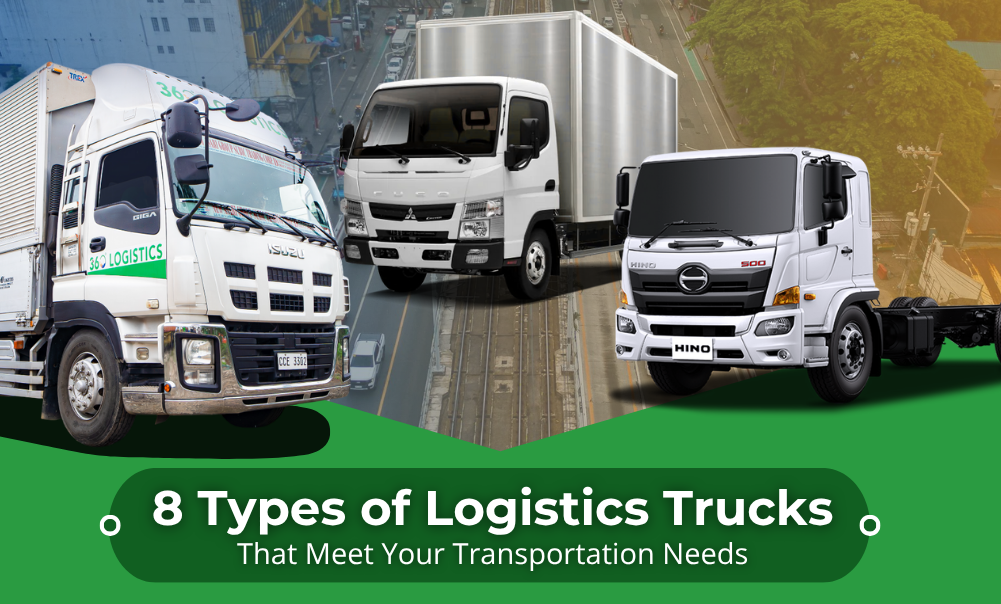
Transport services require the use of diverse logistic trucks, which can be customized according to certain business requirements. Over the years, different types of trucks were developed to accommodate various types of cargo, from palletized and oversized, to frozen and bulk goods. New features and capabilities are introduced to support faster, more efficient loading, storage, and delivery of items.
To make the most of logistic trucks, it is crucial to be aware of the various types a logistics provider can offer. Here is a brief overview of the common types of trucks in the Philippines.
8 Logistics Trucks to Suit Your Business Requirements
-
Box Truck
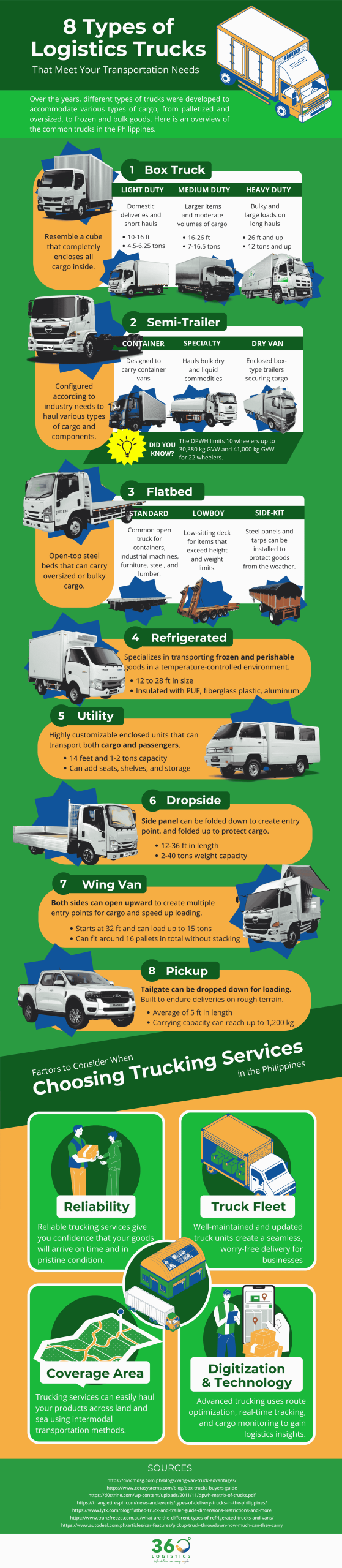
Box trucks resemble a cube that completely encloses all cargo inside. They are also synonymous to ‘straight trucks’, which refers to trailers that are permanently attached to the same chassis. Box types are the most widely-used trucks in various local activities, such as deliveries and moving.
-
Light Duty
Smaller trucks used for domestic deliveries and short hauls. Light-duty box trucks are commonplace in commercial operations. Its size ranges anywhere from 10 to 16 feet with a capacity of 4.5 to 6.25 tons.
-
Medium Duty
Can handle larger items like home appliances and moderate volumes of cargo. Specialized cargo carriers may be required to register for special licenses. Logistic trucks that measure 16 to 26 feet and weigh 7 to 16.5 tons fall into this category.
-
Heavy Duty
Often used by large-scale business operations, with sizes extending 26 feet and beyond, and a weight range of over 12 tons. They are suitable for transporting bulky and large loads on long hauls.
-
Semi-Trailer Truck
Logistic vehicles are typically configured according to industry needs, which is exactly what semi-trailer trucks can achieve. Semi-trailers are used by trucking services in the Philippines to haul various types of cargo and components. Its flexibility can create unique types, such as:
- Container Trailers – Designed to carry container vans, may feature structural support on the chassis for the container or simply a flatbed to load a container.
- Specialty Trailers – Configured to haul bulk dry and liquid commodities (e.g. cement mixers, gas tanks, vehicle carriers)
- Dry Van Trailers – Enclosed box-type trailers that secure cargo from the weather and potential damage
The size and length of a semi-trailer can vary according to its purpose. The Department of Public Works and Highways (DPWH) limits 10 wheelers up to 30,380 kilograms GVW and 41,000 kilograms GVW for 22 wheelers.
-
Flatbed Truck
Flatbed trucks fall under semi-trailers, a versatile solution to carrying bulky, oversized cargo. These trailers can be found as part of almost any logistic fleet, especially those that cater to heavy-duty cargo. Flatbed trucks are made of open-top, fabricated steel beds on which cargo is placed and secured. Different variations of flatbeds are composed of features like removable covering, ramps, and leveled decks, designed for easier loading and unloading. Standard flatbed trailers have an average length ranging 48 to 53 feet, while it can hold a maximum of 24 tons.
-
Standard Flatbed
Common open-top logistic truck made to carry oversized cargo such as containers, industrial machinery, furniture, steel, and lumber.
-
Lowboy
Best suited to trucking services that accept items exceeding height and weight limitations. It features a low-sitting deck behind the gooseneck, where goods are loaded onto. Other variations include the double-drop, drop deck, and removable gooseneck (RGN) trailers.
-
Side-Kit
Designed to protect oversized goods from the weather. Steel panels are assembled along the perimeter of the flatbed, while a large tarp is attached as a roof.
-
Refrigerated Truck
A reefer truck or refrigerated truck is an essential part of a logistics fleet. It specializes in transporting frozen, perishable, or sensitive goods in a temperature-controlled environment. These logistic trucks are fabricated with an insulated box body, consisting of fiberglass plastic and aluminum. For maximum insulation, polyurethane foam (PUF) is inserted in between the inner lining and outer casing of a reefer truck.
The size of reefer logistic vehicles can vary from 12 feet to 28 feet, catering to diverse cargo dimensions. These are commonly used in the agriculture, food and beverage, manufacturing, and pharmaceutical industries.
-
Utility Van
The service van or utility van is another truck used for small-scale domestic deliveries. It is named such due to its versatility, as it can transport both cargo and passengers. A utility van is slightly bigger than the average passenger van, enabling it to carry bigger volumes of lightweight goods. It can also be structured either as pickup or box-type.
Utility trucks are so highly customizable that services like courier, mobile, field repair, and construction outfit it with shelves, seats, and storage units for supplies. Common local trucking services in the Philippines use an L300, with an average length of 14 feet and around 1-2 tons capacity.
-
Dropside Trucks
Logistic vehicles like dropside trucks have features that allow them to accommodate awkward cargo, as well as facilitate a smooth loading process. The dropside has a side panel that can be removed or folded down to create a flat cargo entry point. It can also act as a barrier that protects goods during transport, providing extra security compared to standard flatbeds.
Dropside logistic trucks can be used for light, medium, and heavy-duty haulage (2-40 tons). The smallest size starts around 12 or 15 feet and can go up to 36 feet, depending on the users’ needs.
-
Wing Van
A wing van is designed to streamline loading and unloading. Both sides can open upward, revealing the truck bed. Similar to a conventional truck, it also has a rear door. Wing vans are highly preferred for loading palletized cargo and large volumes of goods using forklifts, as they can be loaded at multiple entry points.
The average size of a wing van starts at 32 feet and can load up to 15 tons. For cargo, this size can fit 16 pallets in total, with ample remaining space for stackable pallets. Most trucking services in the Philippines recommend this vehicle for high-volume and long-haul deliveries.
-
Pickup Truck
The pickup truck is one of the logistics vehicles that can carry passengers and cargo. Its crew cab seats up to two rows of passengers, and is attached to an open, high-lipped cargo rear. Its tailgate can be dropped down for loading and closed back up for added security. Its exterior and engine are built sturdy, and can endure deliveries on rough terrain.
Common pickup truck lengths average around 5 feet while its capacity can reach up to 1,200 kilograms.
4 Factors to Consider When Choosing Trucking Services in the Philippines
1. Reliability
A reliable trucking service in the Philippines gives you confidence that your goods will arrive on time and in pristine condition. Look for a trucking company that provides excellent customization options, customer support, smart tracking capabilities, and clear communication. These qualities not only give you value for money, but also establish good rapport between you and your logistics provider.
2. Coverage Area
Select a logistics company that caters to your business coverage. If you are looking to expand your business, the best option is to try nationwide trucking. Through various intermodal transportation methods, trucking services can haul your products across land and sea with ease.
3. Truck Fleet
Well-maintained and updated truck units create a seamless, worry-free delivery for businesses. Check with your logistics provider if they have the right units and equipment to support your requirements.
4. Digitization and Technology
Route optimization, real-time tracking, and cargo monitoring are some of the modern solutions to common logistics pitfalls. Choose a technologically-advanced trucking provider, through which you can gain better insight on your goods transport.
Trucks are an indispensable part of every logistic fleet, as they are dependable carriers of various cargo. Their flexibility makes trucking services a vital component of the domestic supply chain, as well as key local businesses.
ALSO READ: A Detailed Look into the Different Trucking Services in the Philippines
360 Logistics provides innovative solutions to your logistics needs. We offer LTL, FTL, refrigerated, and containerized trucking in the Philippines, great for every business’ mid to last mile fulfillment. Our diligent team is committed to giving you a reliable, customizable, all-around logistics service no matter where you are.
Connect with us today for a quote.